
Category: Research
-
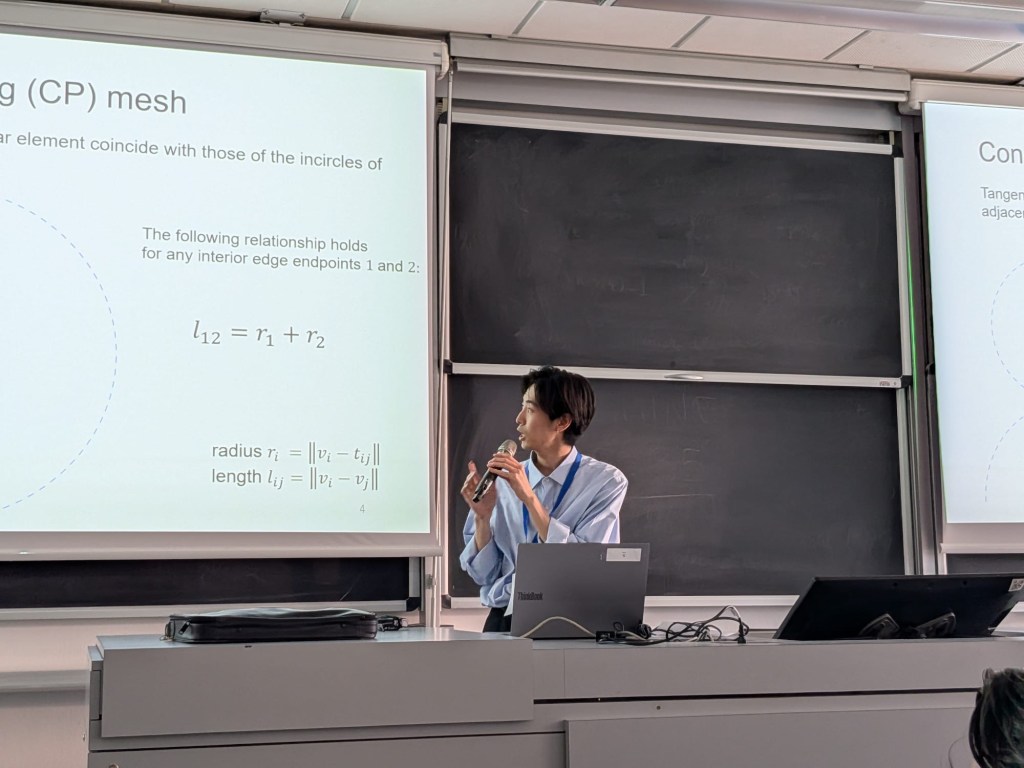
Environmental evaluation of joint system for freeform structures designed by circle packing (CP) mesh
We advised on the approach for environmental evaluation of the “Design of joint system for free-form structure from planar materials based on circle packing meshes.” First author Keiya Sago of Kyoto University presented this conference paper at the “From Architectural Geometry to Structural Geometry” (WG22) session at the International Association for Shell and Spatial Structures…
-
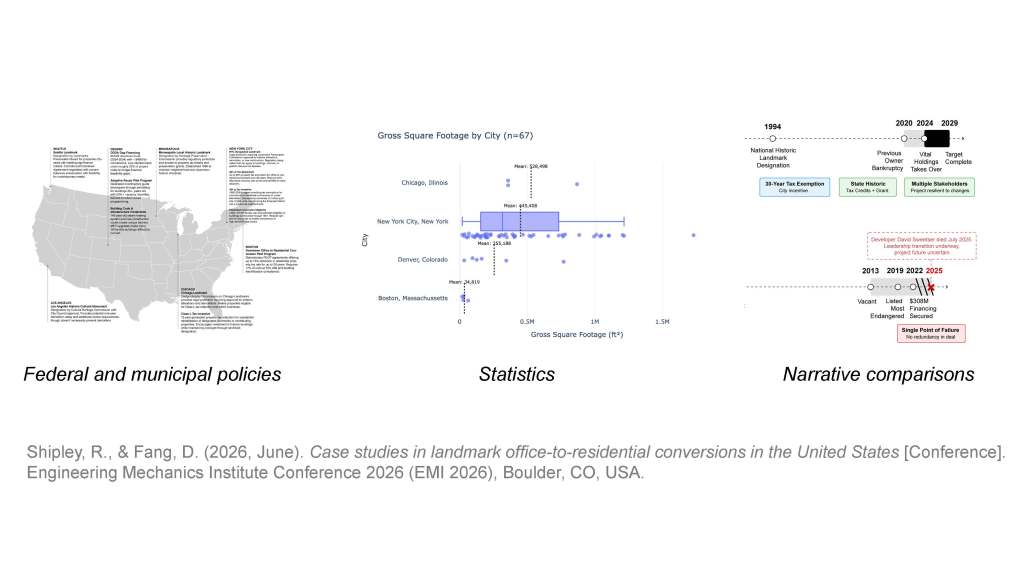
Case studies in landmark office-to-residential conversions in the United States
The demand for office space has uniquely declined in the United States in recent decades. In several cities, this includes tall, historic landmark structures that face obsolescence. Attempts to convert these former office spaces to residential spaces have had mixed success. This presentation summarizes the quantitative and qualitative details of successful, ongoing, and unsuccessful conversions…
-

LENS: Low-carbon Environments through Novel Stakeholder interfaces
We’re pleased to kick off LENS: Low-carbon Environments through Novel Stakeholder interfaces, a CAMD-funded seed grant project focused on improving the curation and design of data with stakeholder input to drive low-carbon design and policy. Our interdisciplinary team proudly spans Architecture, Art+Design, Information Design, Computer Science, and Engineering, and is led by Prof. Demi Fang…
-

“From Data to Decisions” panel at Future of Construction symposium 2026
I was invited to speak at Future of Construction 2026, this year hosted at ETH, on their panel titled “From Data to Decisions”. My talk “Data-driven insights for sustainable structures” touched on ways we leverage data at the building, many-building, and stock scale to reduce embodied carbon during structural design. I enjoyed hearing about the…
-
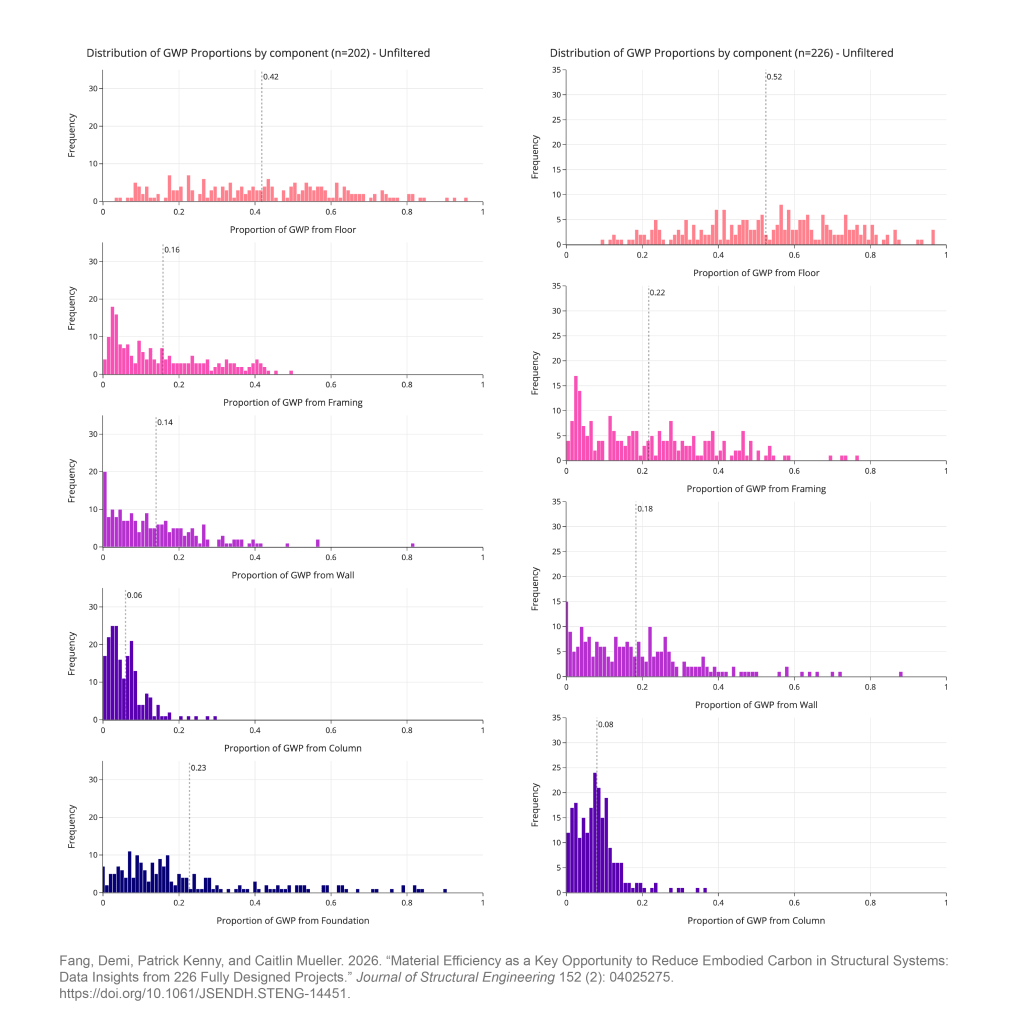
Material efficiency as a key opportunity to reduce embodied carbon in structural systems: Data insights from 226 fully designed projects
Data on embodied carbon in our sector offer unique opportunities to answer key questions about (1) the relative contributions of structural components to emissions, (2) the relationship between material system choice and resulting quantities, and (3) the relationship between material quantities and embodied carbon. Although such analyses have been performed for synthetic data, these types of findings are…
-
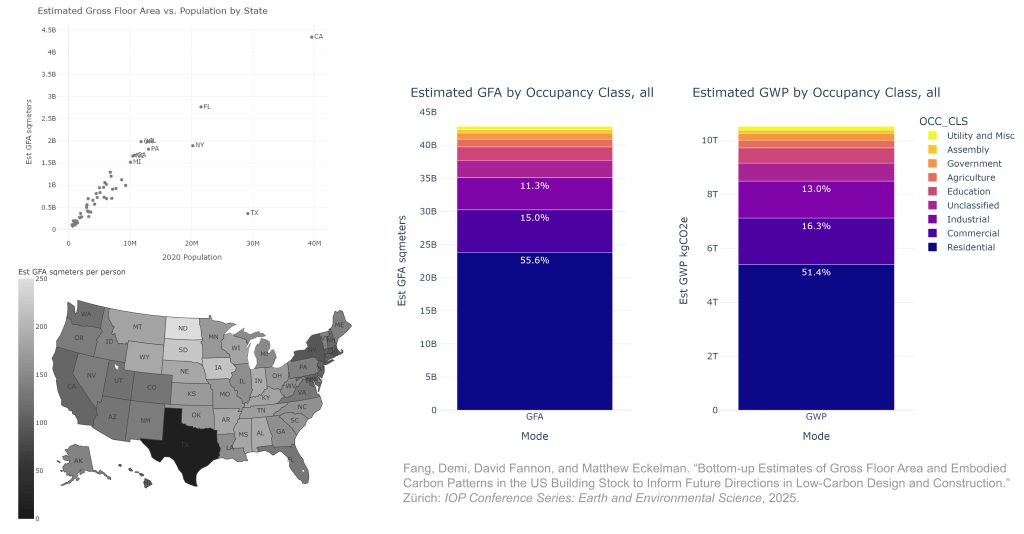
Bottom-up estimates of floor area and embodied carbon patterns in the US building stock
What is the distribution of Gross Floor Area (GFA) and embodied carbon among building types and building sizes in the United States? By count and floor area, the US building stock is dominated by residential buildings, especially small ones. The data are strongly right-skewed: the top 6% of buildings by floor area make up 50%…
-
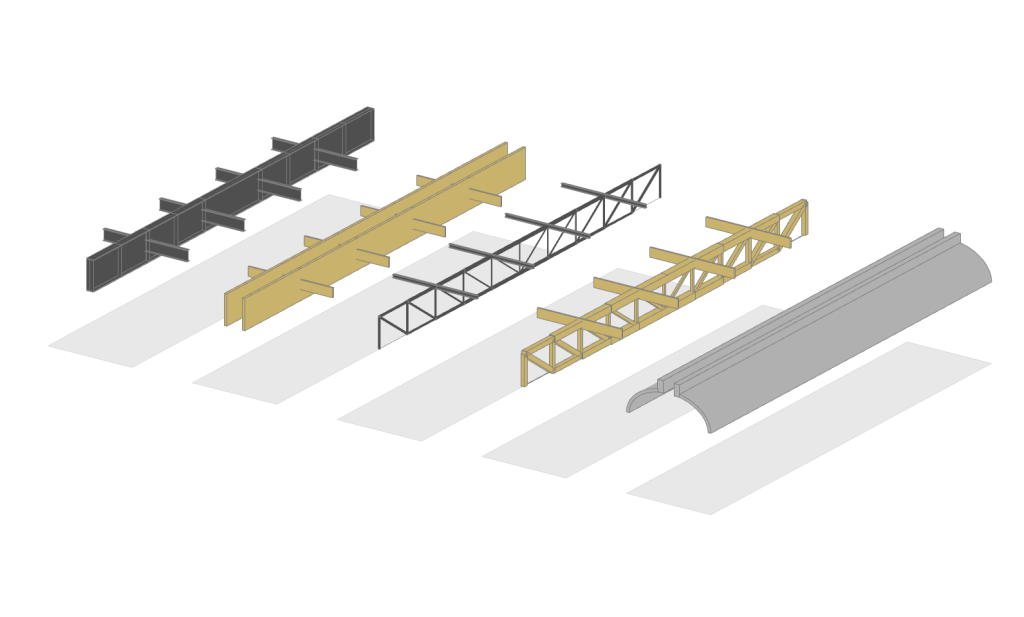
Trans-typology design space exploration: Using gradients to inform decision-making in the design of spanning structures
Does a timber beam or a steel truss result in a lighter structure? Between shortening the span and decreasing the load demand, which results in a more efficient structure? Structural designers pursuing high-performance design must typically make decisions based on perceived tradeoffs. As an alternative to the extreme paradigms of deploying rules of thumb and…
-
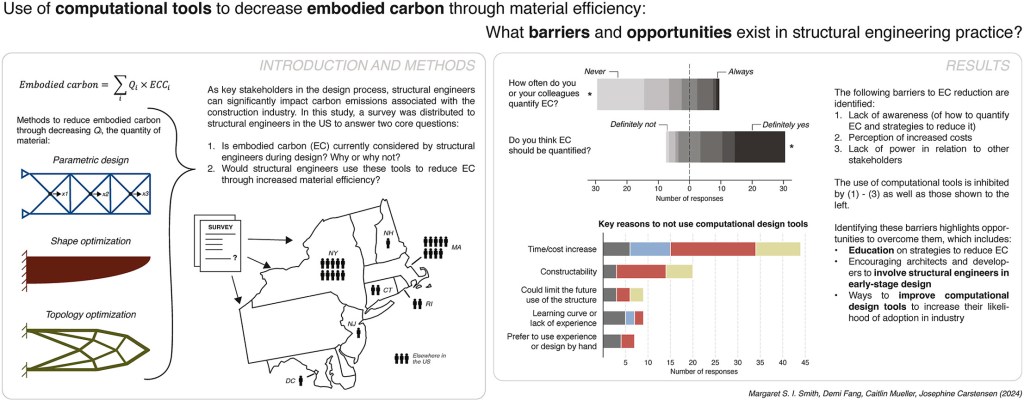
Reducing embodied carbon with material optimization in structural engineering practice: Perceived barriers and opportunities
Structural engineers play an essential role in reducing embodied carbon emissions in buildings, which contribute significantly to global carbon emissions. In this work, 39 structural engineers primarily from the Northeastern US are surveyed on how embodied carbon is reduced in practice, particularly through computational tools that facilitate material efficiency (e.g. parametric design models and structural optimization tools). Leading barriers to…
-
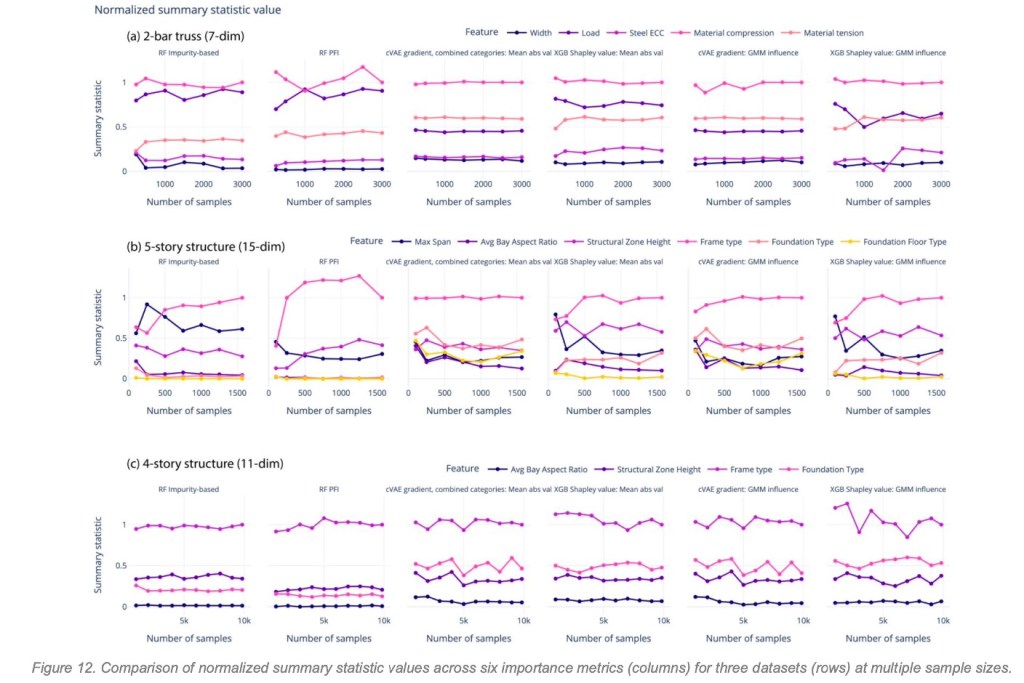
Informing decision-making in single-objective, mixed-variable design problems
Data-driven decision-making in mixed-variable design problems presents a variety of challenges and opportunities, especially in the increasingly data-rich field of emissions in architectural and structural design. Designers can benefit from an underlying knowledge about, for example, whether material choice (discrete) or span (continuous) have more important consequences on structural emissions. This intuition need not be built…
-
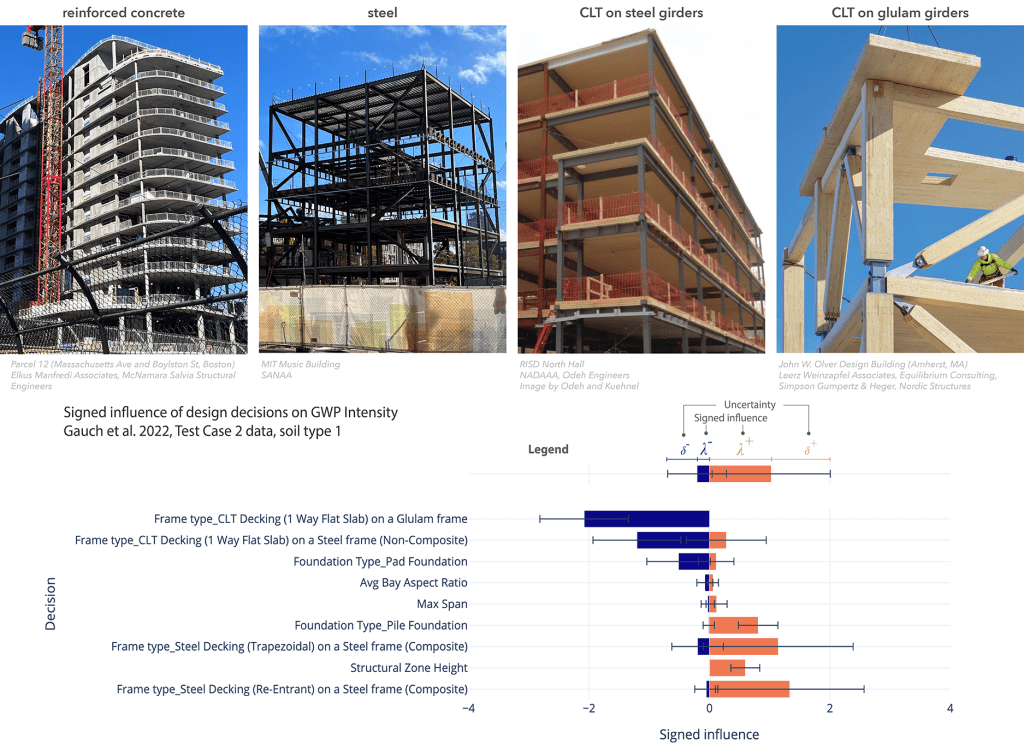
System-level design of low-carbon structures
“What is more likely to be associated with a reduction in emissions: switching from concrete to timber, or shortening the spans throughout the building?” While such insights are valuable for mitigating emissions from structural systems during early stages of design, it is difficult to answer these types of questions in current paradigms of performance-driven design.…

