
The demand for office space has uniquely declined in the United States in recent decades. In several cities, this includes tall, historic landmark structures that face obsolescence. Attempts to convert these former office spaces to residential spaces have had mixed success. This presentation summarizes the quantitative and qualitative details of successful, ongoing, and unsuccessful conversions of 75 landmark office buildings to residential buildings in the United States. Given their size and historic status, the success of their conversions has a nontrivial impact on the urban landscape from both dimensions of preservation and sustainability.
Our presented work summarizes quantitative statistics across these case studies, such as size and conversion cost per square footage. These quantitative data are complemented by qualitative details on each building, such as the heritage status of each building and other documented narratives about success factors or barriers. Our research demonstrates that policy and public perception play an important role in the success of conversions, which are social dimensions that uniquely overlap with the architectural and engineering considerations of conversion.
Taken together, these quantitative and qualitative insights on several key office-to-residential conversions of historic buildings. These findings will help stakeholders anticipate success factors and barriers to high-stakes conversions that can transform the preservation and sustainability performance of cities. Furthermore, the narratives that emerge from this work will be foundational to future work where similar conversions are anticipated elsewhere in the United States based on their lifetimes and vacancy rates.
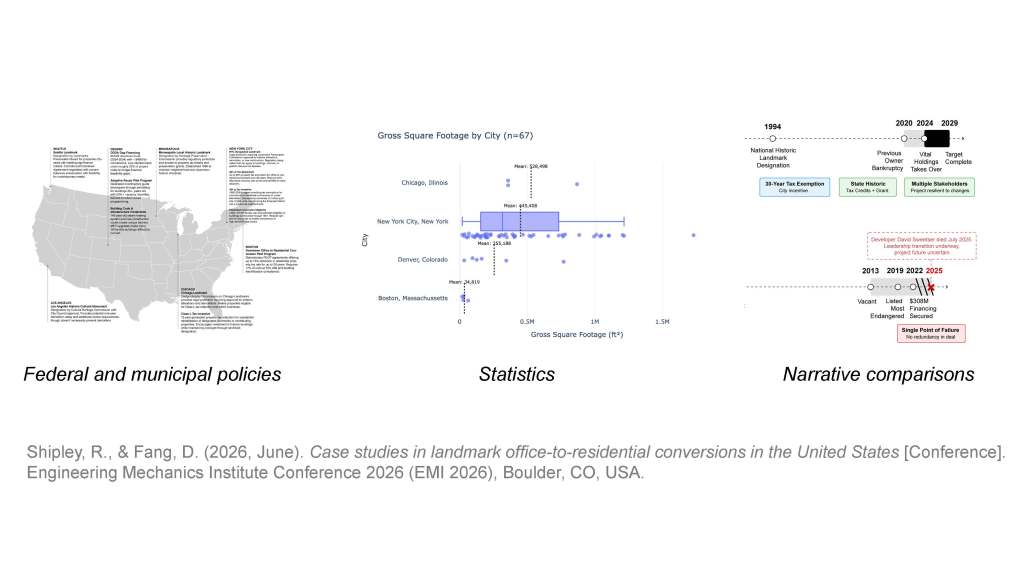
Shipley, R., & Fang, D. (2026, June). Case studies in landmark office-to-residential conversions in the United States [Conference]. Engineering Mechanics Institute Conference 2026 (EMI 2026), Boulder, CO, USA.
 Structural Futures Lab