
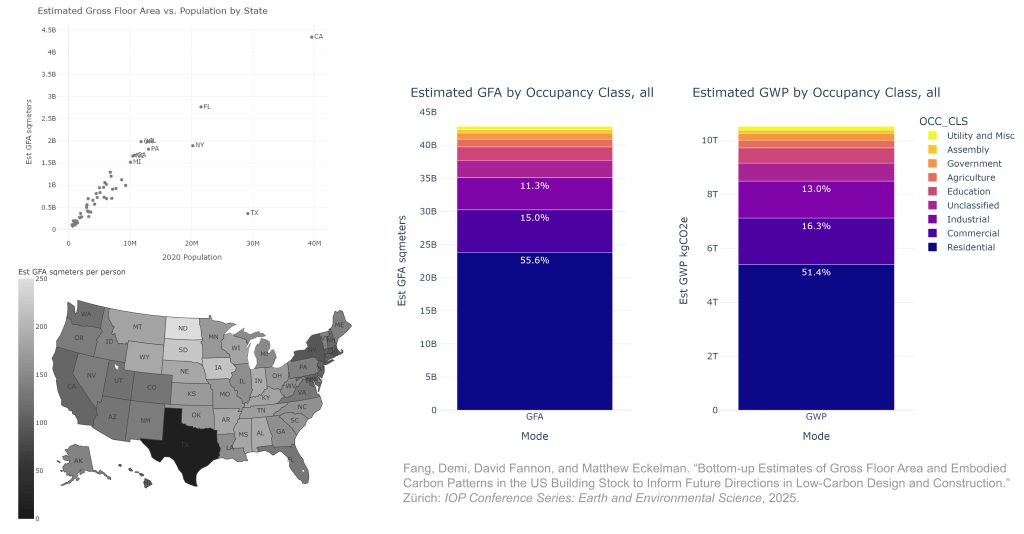
What is the distribution of Gross Floor Area (GFA) and embodied carbon among building types and building sizes in the United States?
By count and floor area, the US building stock is dominated by residential buildings, especially small ones. The data are strongly right-skewed: the top 6% of buildings by floor area make up 50% of the total floor area in the US building stock. A size-based aggregation method preliminarily suggests the top 3% of buildings by embodied carbon are estimated to make up 50% of the embodied carbon in the US building stock.
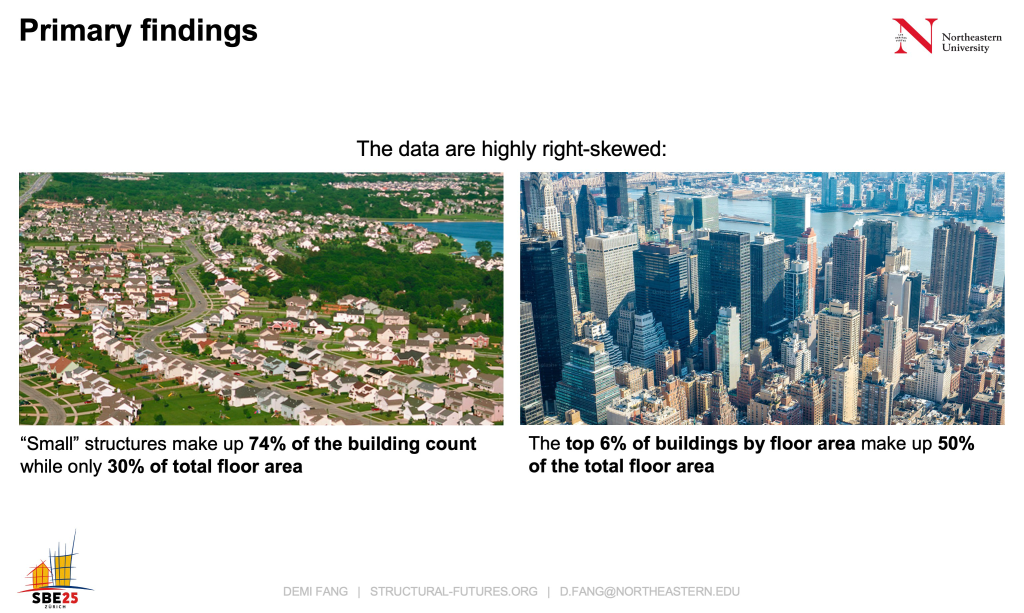
Overall, the nature of the right-skewed data distributions – many small structures and relatively few structures that are large or tall – suggest at least two simultaneous approaches to the design and regulation of low-carbon buildings: 1) implementing any degree of wide-scale reductions in small structures and 2) implementing significant carbon reductions in large structures.
Presented at Sustainable Built Environment 2025 (https://sbe.ethz.ch/) at ETH Zürich, June 2025.
Fang, Demi, David Fannon, and Matthew Eckelman. “Bottom-up Estimates of Floor Area and Embodied Carbon Patterns in the US Building Stock.” IOP Conference Series: Earth and Environmental Science 1554, no. 1 (2025): 012120. https://doi.org/10.1088/1755-1315/1554/1/012120.
Preprint: https://hdl.handle.net/2047/D20723704
 Structural Futures Lab