
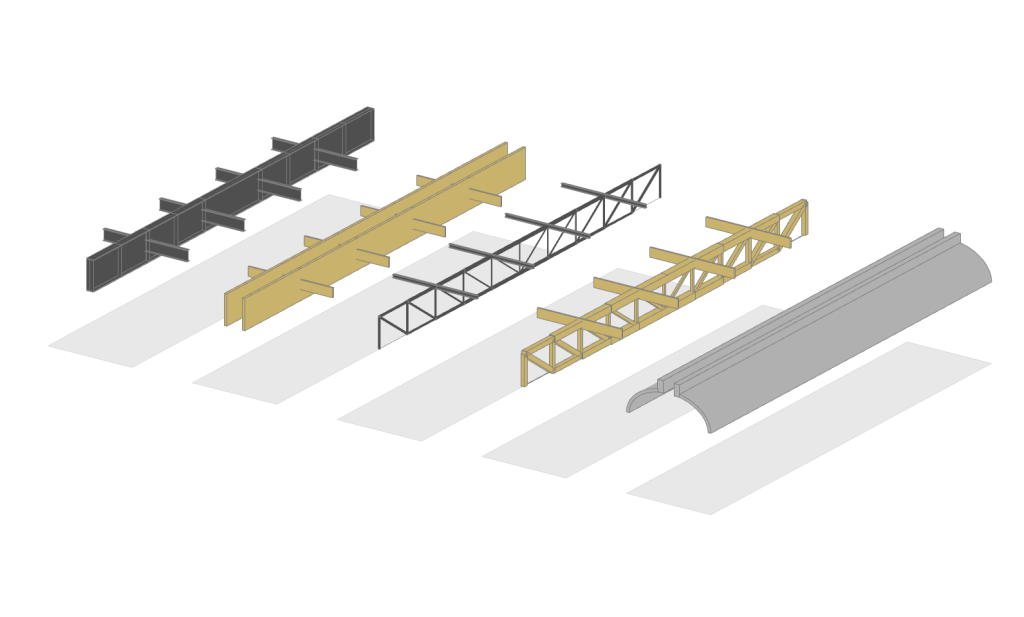
Does a timber beam or a steel truss result in a lighter structure? Between shortening the span and decreasing the load demand, which results in a more efficient structure?
Structural designers pursuing high-performance design must typically make decisions based on perceived tradeoffs. As an alternative to the extreme paradigms of deploying rules of thumb and blackbox optimization, a new paradigm of “performance-informed, human-driven design” is proposed in which designers extract data-driven insights from a provided design space to inform decision-making.
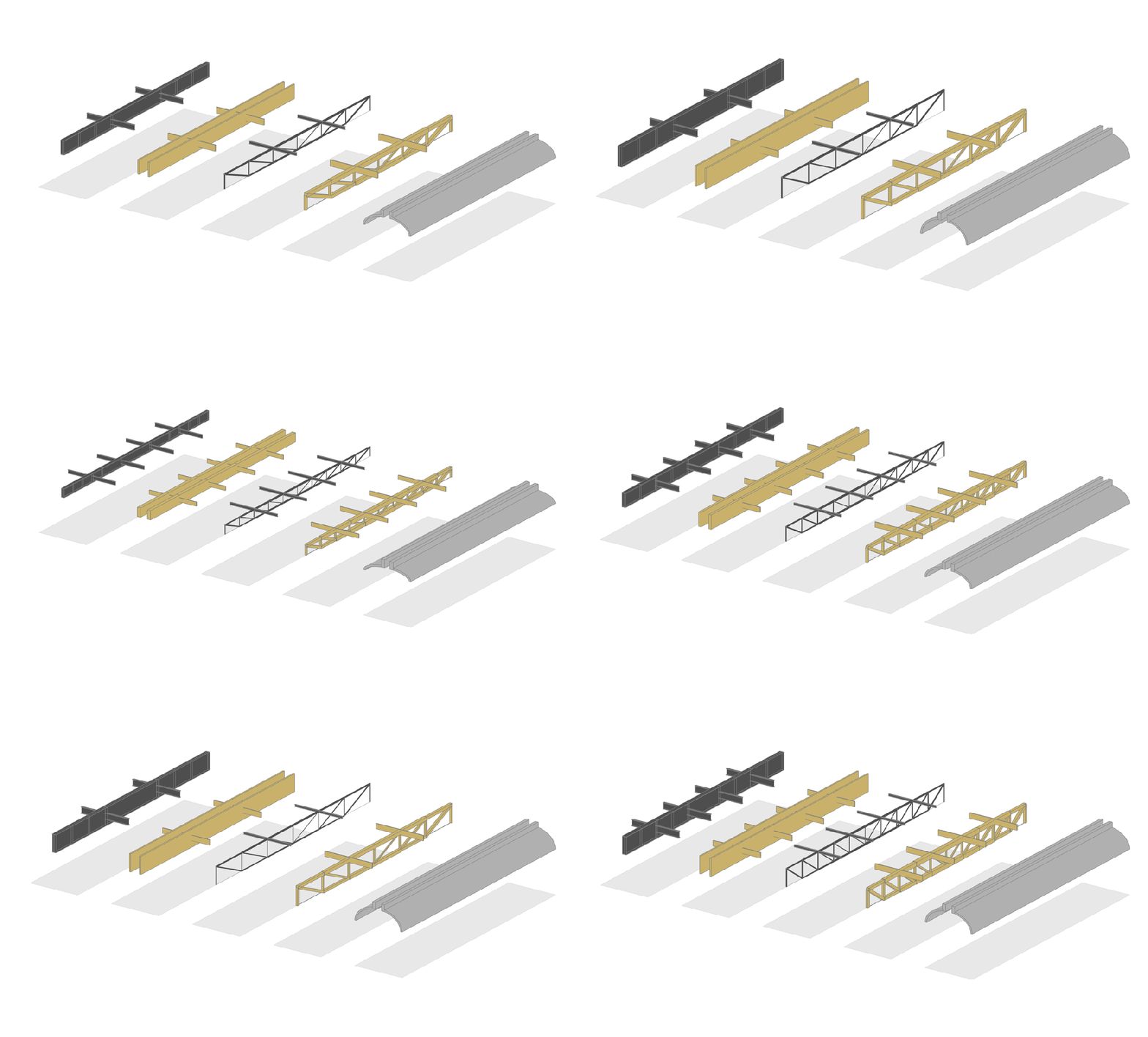
The four-step computational framework entails selecting a sample representative of the design space of interest, training a machine learning model, computing gradients of the model, and computing influence metrics. Applied to the case study of a long-span structure, this paper demonstrates how this gradient-based approach can offer a data-driven way to support and augment intuitions about performance-driven design.
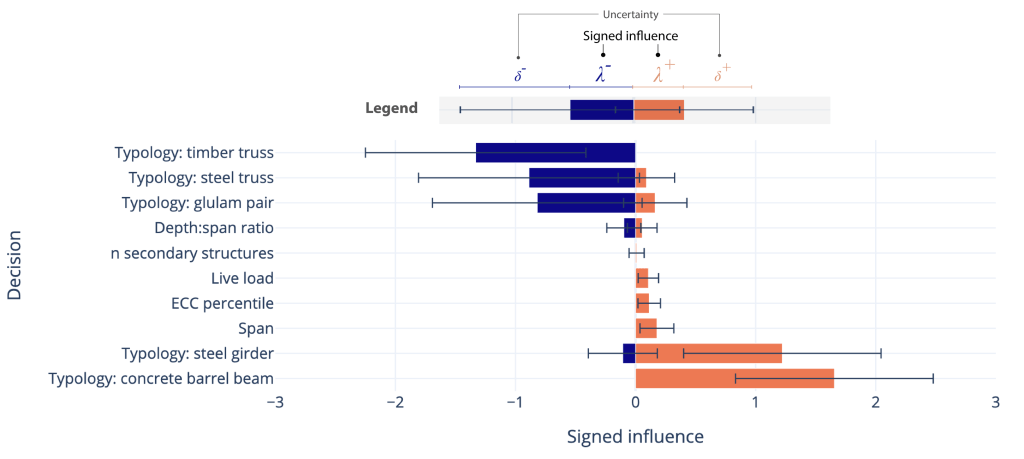
Choice of structural typology is demonstrated to be most associated with large changes of GWP. As designers make decisions that refine the design space of interest, the framework can be iteratively applied at neighborhoods of the original design space, here revealing how priorities of other decisions (span, live load, embodied carbon coefficient) vary by typology. This case study application showcases how decision-making insights tailored to specific problems can be derived from intricate mixed-variable design domains, underscoring the potency of such approaches in informing system-level design processes for low-carbon structures.
Fang, Demi, Peter Wang, Sophia V. Kuhn, Michael A. Kraus, and Caitlin Mueller. “Trans-Typology Design Space Exploration: Using Gradients to Inform Decision-Making in the Design of Spanning Structures.” In Proceedings of the International Association for Shell and Spatial Structures (IASS) Symposium. Zurich, Switzerland, 2024. https://app.iass2024.org/files/IASS_2024_Paper_613.pdf.
 Structural Futures Lab