
In 2019, 16-year-old Greta Thunberg sailed across the Atlantic in 15 days to attend a UN Climate Action Summit, making a point about her values relative to the carbon footprint of transportation. Each year, countless academics who advance research related to mitigating the impacts of climate change travel to conferences around the world.
When I go to such conferences myself, I can’t help but wonder about this elephant in the room. Prof. Julia Steinberger gave the keynote for CISBAT 2023 at EPFL in Lausanne, which I felt especially fortunate to experience in person given she has made similar commitments to Thunberg related to travel (she is based in Lausanne). It was a memorably galvanizing lecture challenging us to advocate for system change as passionately as we do the research for it.
I understand and have experienced the human benefits to international travel and convening with like-minded professionals: pushing your comfort zone, exposing yourself to new environments and cultures, exchanging ideas in community, … the list goes on. At the same time, I would love for us to be able to reap these benefits without the expense of our environment.
(There is a necessary balance between individual and systemic change which I won’t aim to summarize here. I enjoyed this “Data-Driven Guide to Effective Personal Climate Action” by Erika Reinhardt which covers these ideas better than I could.)
I’d love for there to be a time where I feel comfortable swearing off flight travel. Until then, I thought it would be a decent first step to disclose my flight emissions footprint, partially inspired by this LinkedIn post as well as the phrase I’ve usually touted in the work of embodied carbon in buildings: “to reduce emissions, you need to be able to measure them.”
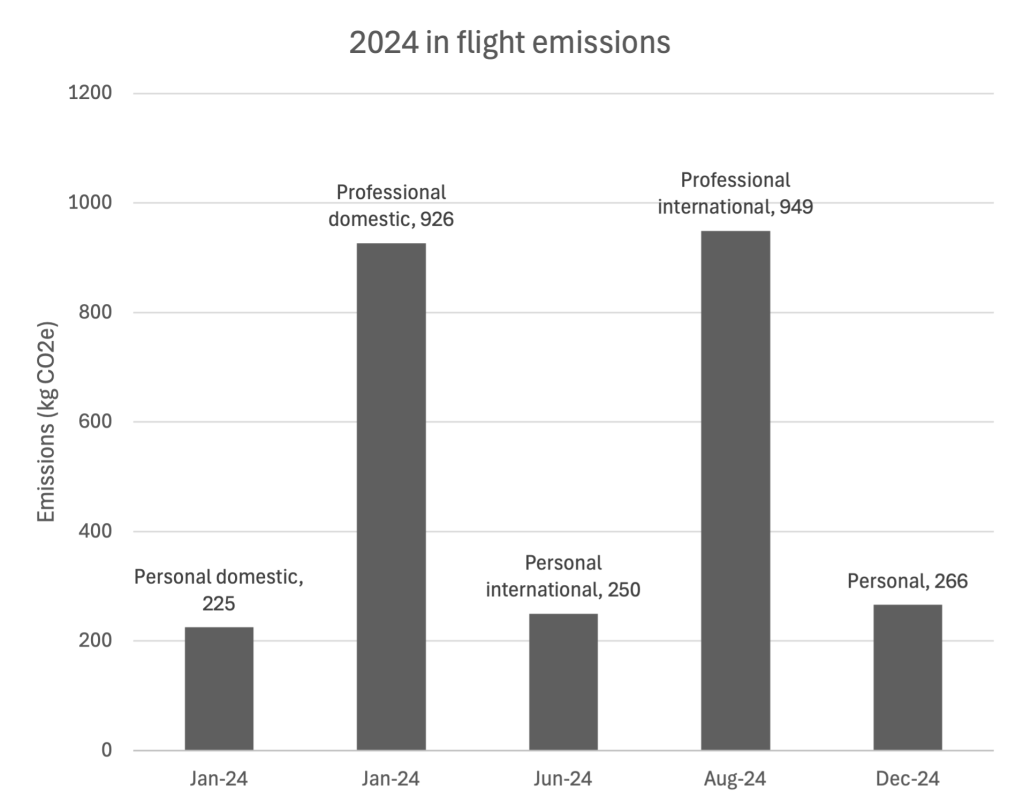
The 8 flights I took in 2024 (three middle bars are round-trip flights) add up to a total of 2616 kg CO2e. These are emissions for the entire flight, not normalized per passenger. I don’t have a car and avoid eating beef; I generally estimate that flights are the largest share of emissions in my life. I can also disclose that I took two round-trip train trips (one personal and one professional) on Amtrak, which (according to Amtrak; I am not running these calculations in detail) represent avoided emissions of about 80% compared to air travel.
On a more qualitative note, on every professional trip I’ve made an effort to connect with friends and family who are nearby the destination. This is probably a natural thing to do from a financial perspective, but it’s also an intention that comes from making the most of my expended emissions, knowing that if I were to fulfill my ideal of giving up flight travel entirely, it would be difficult or impossible to see these contacts.
I’m generally reading that we need to aim for < 2000 kg CO2e per person per year by 2050 to meet the Paris Climate Agreements (need to look more into this statistic and whether transportation emissions are normalized per passenger). Knowing my flight emissions for this year are coming in just above that is useful; I’ll be reflecting on some tangible goals to keep my budget low each year.
 Structural Futures Lab